

If you promote iGaming brands, sooner or later every conversation with a network or affiliate manager comes down to one question: how do you want to be paid?
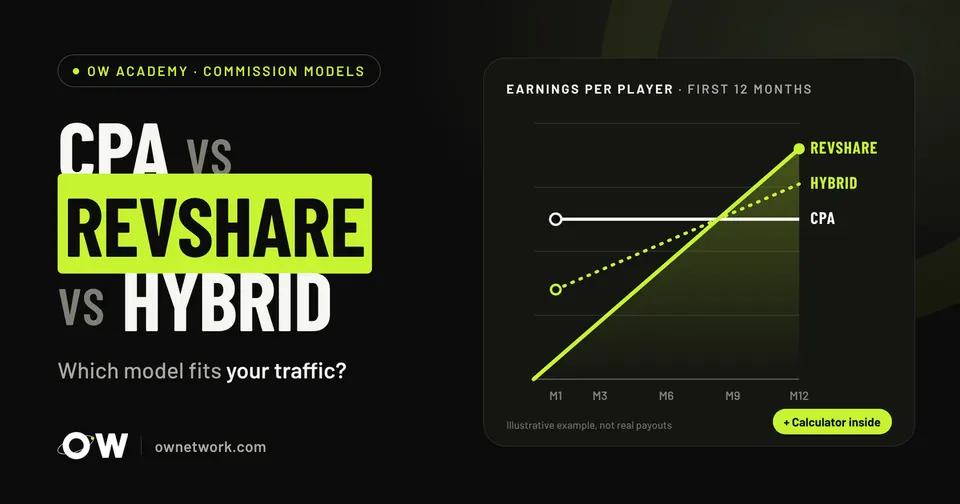
There are three answers on the table. CPA (cost per acquisition) pays a fixed amount for each new depositing player who meets the deal's conditions. RevShare (revenue share) pays a percentage of the net revenue each referred player generates, month after month. Hybrid combines a smaller CPA with a smaller RevShare.
None of them is "the best" in general. The right model is the one that matches how your audience behaves. Let's break each one down, then do the maths.
The quick answer
- Choose CPA if your traffic is high-volume and fast-moving (paid media, one-off influencer campaigns, event spikes).
- Choose RevShare if you own a loyal, returning audience (SEO sites, long-running communities, trusted streamers) and can wait for income to build.
- Choose Hybrid if you want some money upfront without giving up all of the long-term upside, or if you are testing a new GEO or brand.
How CPA works
With a CPA deal, the operator pays you a one-off fee for each qualified FTD (first-time depositor). "Qualified" is the important word. Most CPA deals include a baseline: a set of conditions the player must meet before you are paid. Typical baselines include a minimum first deposit, a minimum total deposit within a period, or a minimum amount wagered.
Why publishers like CPA
- You know exactly what each player is worth to you.
- Cash arrives quickly, usually in the next payment cycle.
- Your income does not depend on whether players win or lose.
What to watch
- Baseline terms. A high CPA with a tough baseline can pay less than a modest CPA with an easy one.
- Caps. Operators often limit how many CPA players they will pay for per month or per GEO.
- Quality reviews. If the players you send churn fast, the operator may lower the rate, cut the cap or move you to RevShare.
- No long tail. Once the CPA is paid, a player who stays for five years earns you nothing more.
How RevShare works
With RevShare, you earn a percentage of the NGR (net gaming revenue) generated by the players you refer, usually for the lifetime of the player.
NGR is not the same as what players lose. Operators start from GGR (gross gaming revenue: stakes minus winnings) and then deduct items such as bonuses, payment fees, platform or game fees and gaming taxes. Every operator defines NGR slightly differently, so always read the deal's definition.
Why publishers like RevShare
- Income grows as your player base grows, and it keeps paying while players stay active.
- A strong portfolio of players becomes a real, recurring asset.
- There is usually no cap on how many players you can refer.
What to watch
- Negative carryover. If your players win more than they lose in a month, your balance can go negative. With negative carryover, that deficit is deducted from future earnings. Many networks now offer deals without it, or reset it monthly. Ask.
- Admin fees. Some programmes deduct a percentage before your share is calculated.
- Slow start. It can take months before RevShare overtakes what a CPA would have paid upfront.
- Variance. A single high-rolling player can move your monthly figure dramatically, in either direction.
How Hybrid works
A Hybrid deal pays a reduced CPA for each qualified FTD plus a reduced RevShare on that player's NGR. For example, instead of a full CPA or a full RevShare, you might receive a smaller fixed fee and a lower percentage at the same time.
Hybrid is popular for good reasons. It gives you cash flow to reinvest in traffic, it keeps you exposed to long-term player value, and it aligns your interests with the operator's: you both win when players stay.
The trade-off is simple: you give up some of the upside of each pure model in exchange for lower risk.
Which model fits which traffic?
| Traffic type | Typical behaviour | Usually fits best |
|---|---|---|
| Paid media (search, social, native, programmatic) | High volume, fast testing, costs paid upfront | CPA or Hybrid |
| SEO and review sites | Steady, returning, high-intent visitors | RevShare or Hybrid |
| Influencers and streamers | Spiky around campaigns or live sessions; loyal core audience | Hybrid |
| Telegram, WhatsApp and community channels | Engaged, repeat audience; quality varies by community | RevShare or Hybrid |
| Email and CRM lists | Re-activation of known users | Hybrid |
| Event-driven sports traffic (finals, tournaments) | Big short-term peaks | CPA |
Treat this table as a starting point. Your own data — how long your players stay and how much they deposit — should make the final decision.
The break-even calculator: do the maths before you sign
You do not need a complex tool to compare deals. You need three numbers from your own history or from a test campaign:
- A = average monthly NGR per active player
- L = average number of months a player stays active
- R = the RevShare percentage offered
Step 1 — Estimate lifetime RevShare per player
Lifetime RevShare per player = A × L × R
Step 2 — Compare it with the CPA on offer
If A × L × R is higher than the CPA, RevShare should pay more over time. If it is lower, CPA wins.
Step 3 — Value the Hybrid
Hybrid value per player = Hybrid CPA + (A × L × Hybrid RevShare %)
Step 4 — Find your break-even month
Break-even month = CPA ÷ (A × R)
This tells you how many months of RevShare it takes to match the CPA you would have been paid upfront.
A worked example (illustrative numbers only)
Imagine a deal that offers a choice of a USD 100 CPA, 35% RevShare, or a Hybrid of USD 50 CPA plus 20% RevShare. Your test data shows players generate an average of USD 40 NGR per month and stay active for eight months.
| Model | Calculation | Value per player |
|---|---|---|
| CPA | Fixed fee | USD 100 |
| RevShare | 40 × 8 × 35% | USD 112 |
| Hybrid | 50 + (40 × 8 × 20%) | USD 114 |
Break-even for RevShare: 100 ÷ (40 × 35%) = about 7.1 months.
In this example, Hybrid pays slightly more than RevShare and gives you half of the money upfront. But change one input — say players only stay four months — and CPA becomes the clear winner. That is why your own retention data matters more than any rule of thumb.
These figures are examples for illustration, not typical market rates. Real rates vary by GEO, vertical, brand and traffic quality.
Developer note: this section can be turned into an interactive calculator with four inputs (A, L, R and CPA) and three outputs (CPA, RevShare and Hybrid value, plus break-even month).
Why deals vary by region
The same brand may offer very different terms in different markets. Several factors drive this:
- Player value. Markets with higher average deposits and longer player lifetimes support higher deals but also demand a track record.
- Taxes and fees. Higher gaming taxes reduce NGR, which reduces RevShare — and often pushes operators to adjust CPA too.
- Regulation. Some regulators restrict how affiliates may be paid. In the US, rules are set state by state, and some regulators have scrutinised performance-based deals for sports betting affiliates — Massachusetts, for instance, initially restricted CPA and revenue-share arrangements before relaxing its rules.
- Competition. In crowded markets, operators compete hard for quality traffic, which can push rates up.
This is why a good network will quote deals by GEO rather than offering one global rate.
Seven questions to ask before you sign any deal
- What exactly is the baseline for a qualified FTD?
- How is NGR defined, and which costs are deducted?
- Is there negative carryover, and if so, does it reset monthly?
- Are there monthly caps, and what happens to players above the cap?
- What are the payment terms, minimum payout and currencies?
- Can I track by sub-ID and receive server-to-server (S2S) postbacks?
- Can I renegotiate or switch models once I have performance data?
How OW Network works with publishers
OW Network connects publishers — review sites, bloggers, streamers, influencers, community owners and media buyers — with iGaming advertisers across regulated markets. We offer CPA, RevShare and Hybrid deals, and terms are set by region and by brand, so you can match each deal to the GEO and the traffic you actually have.
Not sure which model suits your audience? Talk to us before you commit. We would rather help you choose the deal that keeps paying you than sign you to one that just looks big on day one.
Join OW Network
FAQ
What is the difference between CPA and RevShare? CPA pays a fixed, one-off fee for each player who makes a qualifying first deposit. RevShare pays a percentage of the net gaming revenue each referred player generates over time.
Is RevShare better than CPA? Not automatically. RevShare tends to pay more when players stay active for a long time; CPA tends to pay more when players churn quickly or when you need cash upfront.
What is a Hybrid deal in affiliate marketing? A Hybrid deal pays a reduced CPA per qualified player plus a reduced RevShare on the revenue that player generates.
What is negative carryover? It is when a negative monthly balance on a RevShare deal — usually because players won more than they lost — is carried forward and deducted from your future earnings.
What is a CPA baseline? The minimum conditions a player must meet, such as a minimum deposit or wagering amount, before the affiliate is paid the CPA.
Can I switch from CPA to RevShare later? Often, yes. Many networks allow you to renegotiate once you have performance data. Ask whether existing players move to the new model or stay on the old one.
18+. This article is for affiliates and media professionals, not players. Gambling involves risk. Promote only brands licensed in the market you target, and always include responsible-gambling messaging. If gambling stops being fun, seek help from a local support service.